Every January, business owners feel the pressure to plan bigger goals.
More revenue.
More visibility.
More growth.
But here’s the hard truth: goals don’t fail because they’re too ambitious — they fail because the systems underneath them aren’t strong enough.
If your business feels heavier than it should, harder to manage, or overly dependent on you, it’s not a motivation problem. It’s usually a systems problem.
That’s why, as we head into 2026, systems matter more than goals.
The Problem With Goal-First Planning
Most businesses are taught to start the year by asking:
Those are important questions — but they’re second-order questions.
When systems are missing or inconsistent, goals create pressure instead of momentum. You find yourself:
Making the same decisions over and over
Manually handling tasks that should be automatic
Reacting instead of planning
Feeling busy but not necessarily effective
Over time, that leads to decision fatigue, stress, and burnout, even if the business looks “successful” on paper.
What Systems Actually Do for Your Business
Systems aren’t about complexity or losing control. At their best, systems exist to protect you.
Good systems:
Reduce the number of daily decisions you have to make
Create consistency without constant effort
Make your business easier to run — not harder
Allow you to step away without everything falling apart
In short, systems give your strategy something solid to stand on.
January Is the Perfect Time to Focus on Foundations
Instead of treating January as a sprint toward new goals, consider treating it as foundation month.
This is the moment to ask:
What in my business still relies too heavily on me?
What feels more manual than it should?
Where am I repeating the same work or answering the same questions?
You don’t need to overhaul everything at once. In fact, the most effective system builders start small.
The Core Systems Every Business Needs (Before Scaling)
Before focusing on growth, most businesses benefit from strengthening these five areas:
1. Lead & Inquiry Handling
Is there a clear process when someone reaches out?
Do leads get follow-up without you remembering?
When this isn’t systemized, opportunities quietly slip through the cracks.
2. Marketing & Visibility
Is your content consistent — or dependent on how busy you are that week?
Do people know how to find and contact you?
Systems here create visibility without constant effort.
3. Client Communication
Do clients know what happens next after they book or inquire?
Is information stored in one place?
Clear systems reduce confusion for everyone — including you.
4. Reputation & Trust
Are reviews monitored and responded to?
Is social proof visible where people are deciding whether to work with you?
Trust-building systems work quietly, but powerfully.
5. Reporting & Awareness
Do you know what’s working in your business — or are you guessing?
Are decisions data-informed or reactive?
Even basic reporting can dramatically reduce uncertainty.
Systems First. Strategy Second.
This doesn’t mean goals don’t matter. It means goals work better when systems are already doing their job.
When your foundation is solid:
That’s the energy worth carrying into 2026.
A Simple Next Step
If you’re not sure where your systems stand, start with awareness.
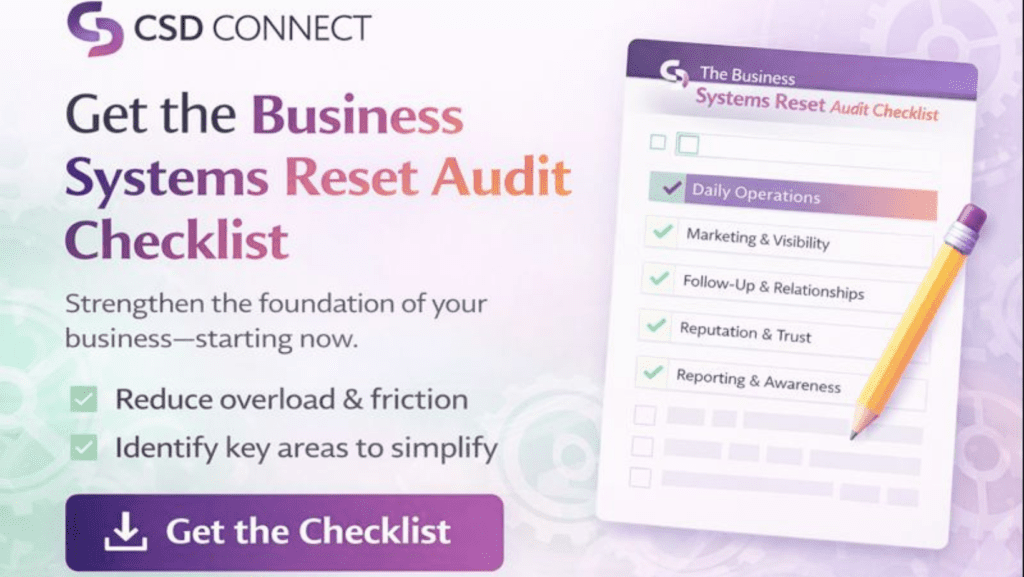
I created a short Business Systems Reset Audit to help business owners quickly identify where their business is supporting them — and where it may still be relying too heavily on them.
It takes about five minutes and gives you a clear starting point.
 Take the 5-minute Business Systems Reset Audit
And if you’re ready to explore tools that centralize, automate, and simplify the day-to-day, CSD Connect was built to support this exact stage of business — without adding unnecessary complexity.
Explore CSD Connect tools
Final Thought
If your business feels heavier than it should, that’s not a failure.
It’s feedback.
And systems are how you respond to it.


 Take the 5-minute Business Systems Reset Audit